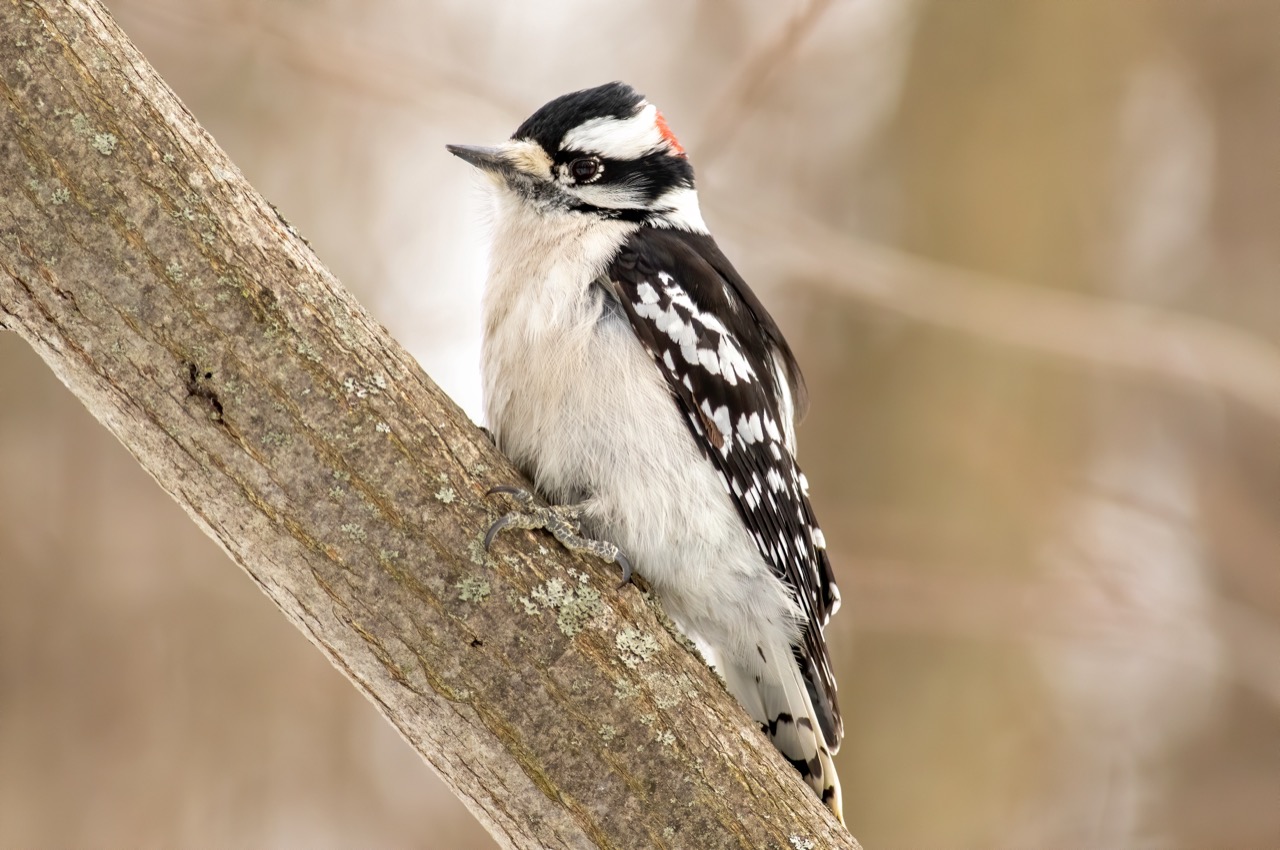
The Downy Woodpecker, known scientifically as Picoides pubescens, is a captivating species that not only enchants birdwatchers but also plays a pivotal role in its ecosystem. This tiny bird, often mistaken for its larger cousin the Hairy Woodpecker, is a staple in both urban and rural landscapes across North America. Its ability to adapt to various environments and its intriguing behaviors make it a fascinating subject for both scientific study and casual observation.
Characteristics / Physical Description
The Downy Woodpecker is the smallest woodpecker in North America, measuring approximately 14 to 18 centimeters in length with a wingspan of about 25 to 30 centimeters. It features a striking black and white color pattern, with white underparts, black wings spotted with white, and a white stripe down the back. Males are distinguished by a small red patch on the back of their head, which is absent in females. Their size and the pattern of barring on the outer tail feathers help distinguish them from the similar Hairy Woodpecker.
Taxonomy and Classification
Picoides pubescens belongs to the family Picidae, which encompasses all woodpecker species. This bird is further classified under the genus Dryobates. There are several recognized subspecies of the Downy Woodpecker, differing slightly in size and markings depending on their geographic location.
Behavior and Social Structure
Downy Woodpeckers are known for their agility and can often be seen hanging upside down on tree limbs or hopping along tree trunks in search of food. They are primarily solitary but are also seen in pairs or small family groups, especially during breeding season. They communicate through a variety of sounds including short whinnies and sharp ‘pik’ notes, and they use drumming on trees as a form of communication, particularly to establish and defend territory.
Habitat and Distribution
The Downy Woodpecker is widely distributed across North America, from Alaska and Canada down through the United States to Mexico. They thrive in a variety of habitats including deciduous and coniferous forests, woodlands, orchards, parks, and suburban gardens. Their adaptability to different environments, including urban areas, has allowed them to maintain stable population levels even where other species have declined.
Diet and Feeding Habits
Omnivorous in nature, the diet of the Downy Woodpecker includes insects, seeds, berries, and occasionally tree sap. They are particularly fond of beetles, ants, and caterpillars. During winter, when insects are scarce, they commonly visit bird feeders for suet and black oil sunflower seeds, making them a familiar sight in backyard feeders.
Breeding and Reproduction
Downy Woodpeckers are monogamous during the breeding season. They nest in cavities that they excavate in dead wood or in old trees. The female lays four to five white eggs, which both parents incubate for about 12 days. Both parents also participate in feeding the chicks, which fledge approximately 20 to 25 days after hatching.
Relationship with Humans
Downy Woodpeckers generally benefit from their relationship with humans, as they are able to exploit bird feeders and use dead trees in managed forests for nesting. They also play a beneficial role in controlling insect populations, including pests harmful to trees and crops.
Evolutionary History
Woodpeckers are an ancient group, with fossil records dating back to the Miocene. The specific evolutionary history of the Downy Woodpecker traces back through the woodpecker family tree, showing adaptations such as strong beaks and skull structures to withstand repeated impacts, and stiff tail feathers to support their weight as they climb.
Use as Research Animals
While not typically used in laboratory research, Downy Woodpeckers are often subjects of ecological and behavioral studies in their natural habitats. Research on their feeding habits, for example, helps in understanding the dynamics of forest ecosystems and the impacts of environmental changes on bird populations.