Sloths are among the most peculiar and intriguing creatures in the animal kingdom, captivating the hearts of those who encounter them in the tropical forests of Central and South America. These animals are renowned not only for their slow movements but also for their unique adaptations to a life spent predominantly in the trees. In a world that values speed, sloths remind us of the evolutionary advantage of taking it slow and the ecological importance of their existence.
Characteristics / Physical Description
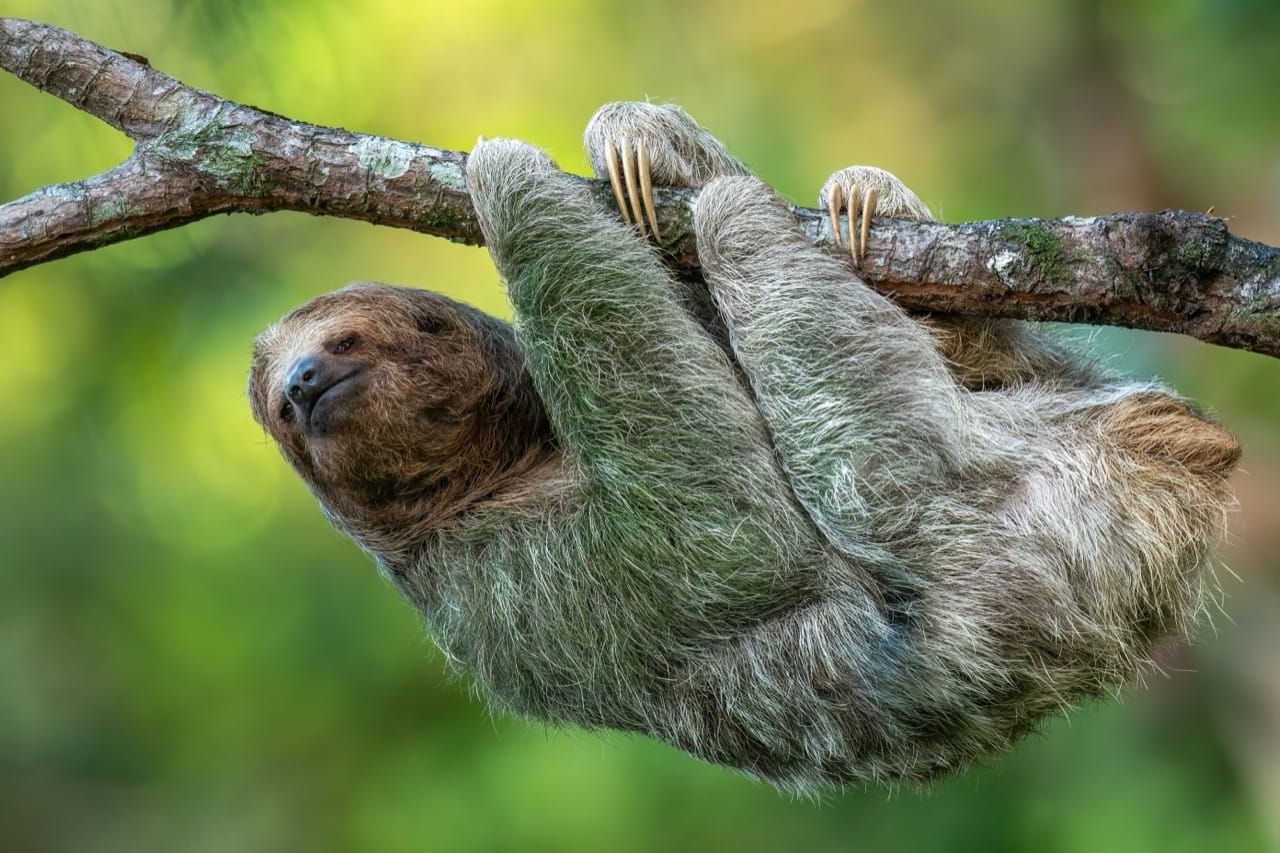
Sloths are medium-sized mammals with a distinctive appearance that includes long limbs, a short snout, and a face that seems to be perpetually smiling. Their fur, which varies from light brown to gray, hosts symbiotic algae that provide camouflage among the green foliage. This fur is coarse and thick, designed to repel water and keep the sloth dry in the humid environment. Sloths possess long, curved claws that are crucial for hanging onto branches, allowing them to maintain their grip while sleeping or feeding.
Taxonomy and Classification
Sloths belong to the order Pilosa, which they share with anteaters, and are classified into two families: two-toed sloths (Choloepus spp.) and three-toed sloths (Bradypus spp.). Despite their common names, all sloths have three toes on their hind limbs; the distinction lies in the number of fingers on their forelimbs.
Behavior and Social Structure
Sloths are solitary creatures, coming together only during the breeding season. Their slow movements are an energy-conserving strategy that complements their low-energy diet. This lethargic lifestyle also helps them avoid detection by predators such as jaguars and eagles. Sloths are also known to descend from their arboreal homes only once a week to defecate, which is one of the few times they are vulnerable to predation.
Habitat and Distribution
Sloths are found in the tropical rainforests of Central and South America, from Nicaragua down to Brazil. They inhabit a range of forest types, including deciduous and evergreen varieties, where they spend almost their entire lives in the canopy. The continuous canopy allows them to move and feed without ever needing to come to the ground, where they are awkward and vulnerable.
Diet and Feeding Habits
Sloths are herbivores, feeding primarily on leaves, twigs, and fruit. Their diet is low in nutrients and hard to digest, which is why they have a large, multi-chambered stomach that slowly ferments the food to extract the maximum amount of nutrients. This slow digestion process complements their overall sluggish lifestyle.
Breeding and Reproduction
The reproductive rate of sloths is slow; females typically give birth to a single offspring after a gestation period of about six months. The young are cared for by their mothers for up to a year, clinging to their mother’s belly and learning what to eat and how to survive in the treetops.
Relationship with Humans
Historically, sloths have not been directly significant to human economies or cultures, but they are increasingly becoming symbols of wildlife conservation and the ecological challenges facing tropical forests. They are popular in zoos and are charismatic ambassadors for conservation efforts aimed at preserving their natural habitats.
Evolutionary History
Sloths are part of an ancient lineage of mammals that dates back over 60 million years. They were once much larger, with some extinct species like the Megatherium being as large as modern elephants. The evolution of sloths is a testament to the diverse and dynamic history of mammals in the Americas.
Use as Research Animals (if applicable)
Currently, sloths are not typically used as research animals due to their specialized needs and slow metabolism. However, they are subjects of ecological and environmental studies that aim to understand better the dynamics of tropical ecosystems and the impacts of climate change and deforestation on arboreal wildlife.