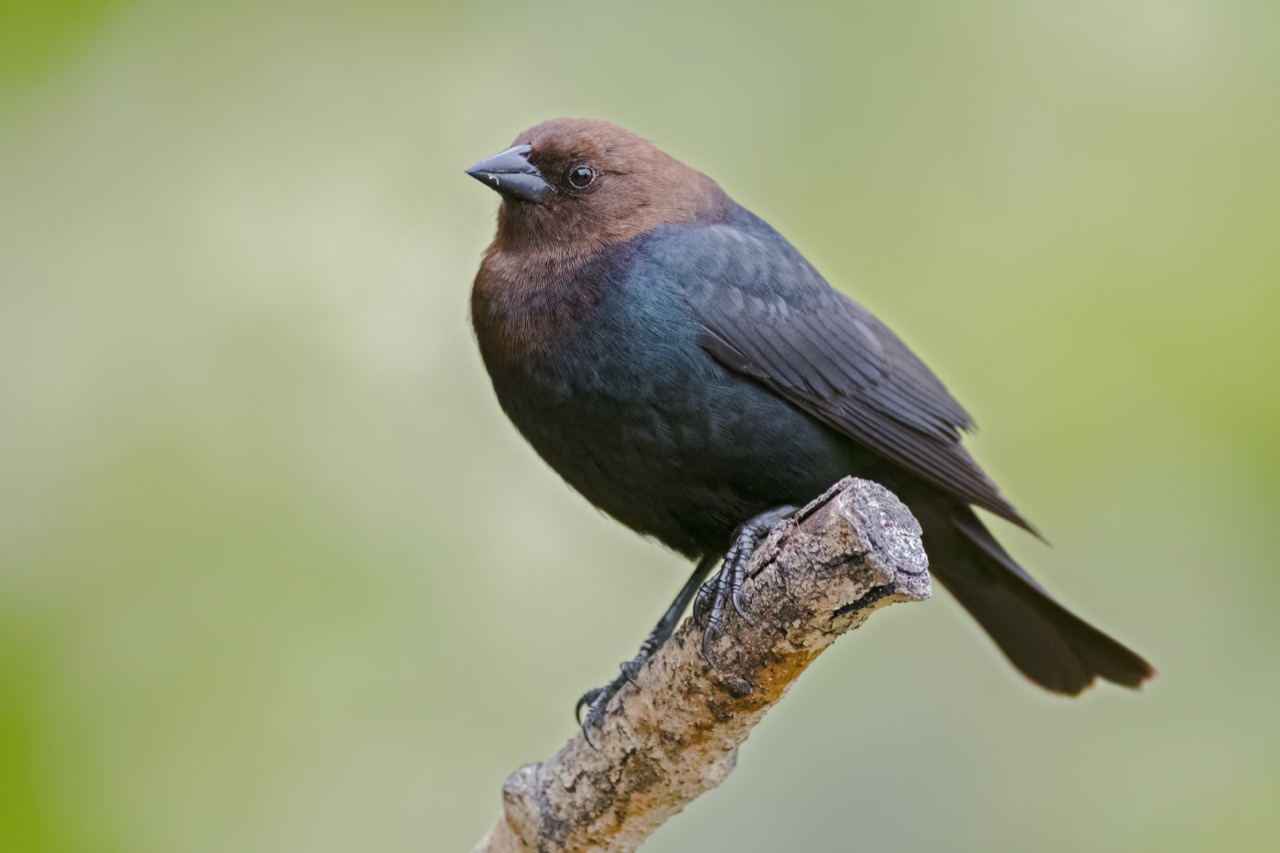
The brown-headed cowbird (Molothrus ater), often seen as a villain in the avian world, is in fact a fascinating example of survival and adaptability. With its sleek black body and distinctive brown head, this bird is notorious for its unusual reproductive strategy known as brood parasitism. This article explores the intricate life of the brown-headed cowbird, shedding light on its behaviors, ecology, and the complex relationships it shares with other bird species.
Characteristics / Physical Description
The brown-headed cowbird is a medium-sized bird, typically measuring about 7.5 inches in length and weighing around 1.5 to 2 ounces. Males are distinguished by their glossy black bodies and brown heads, while females are generally duller with grayish brown plumage. Neither sex has distinctive markings or color variations apart from the head, making them relatively easy to identify among other bird species.
Taxonomy and Classification
Belonging to the family Icteridae, which includes blackbirds, grackles, and orioles, the brown-headed cowbird is a unique member due to its parasitic breeding behavior. It is classified under the genus Molothrus, which is Latin for “vagrant” or “wanderer,” a nod to its nomadic lifestyle.
Behavior and Social Structure
Cowbirds do not raise their own young; instead, they lay their eggs in the nests of other bird species. An adult female can lay up to 40 eggs in a single season, distributing them among the nests of over 200 different species of birds. This behavior ensures that at least some of her offspring will survive, even if others are rejected or outcompeted by host chicks.
Habitat and Distribution
Originally inhabitants of the North American prairies, brown-headed cowbirds have expanded their range dramatically with the clearing of dense forests and the expansion of agricultural land. They are now found across most of North America, from Canada to Mexico, adapting readily to a variety of habitats including woodland edges, grasslands, and suburban areas.
Diet and Feeding Habits
As opportunistic feeders, brown-headed cowbirds have a varied diet that includes insects, seeds, and grains. Their feeding behavior often aligns with their parasitic lifestyle, as they need to be mobile and flexible to find host nests and food sources across a broad geographic area.
Breeding and Reproduction
The breeding season of the cowbird is particularly interesting due to its parasitic nature. Females meticulously monitor potential host nests, and once a suitable one is found, they will remove one egg from the nest and replace it with one of their own. The host parents then unwittingly raise the cowbird chick as their own, often at the expense of their biological offspring.
Relationship with Humans
The relationship between humans and cowbirds is complex. While cowbirds have benefited from human alterations to the landscape, they are often viewed negatively due to their impact on populations of other songbirds, some of which are threatened or endangered. Management strategies have included trapping and relocating cowbirds in sensitive areas to protect vulnerable bird species.
Evolutionary History
The evolutionary pathway of the brown-headed cowbird is deeply intertwined with the bison of North America, following these large grazers and feeding on the insects stirred up by their movement. As bison populations dwindled and landscapes changed, cowbirds adapted to new environments and hosts, showcasing their remarkable evolutionary flexibility.
Use as Research Animals
Brown-headed cowbirds have become important research subjects in studies of animal behavior, particularly in the field of brood parasitism. Their impact on host species has also made them a focus in conservation biology, helping scientists understand the dynamics of interspecies relationships and the ecological consequences of human land use.
In summary, the brown-headed cowbird is a species that challenges our perceptions of what it means to be a parent in the natural world. Its survival strategy, while controversial, offers incredible insights into the complexities of evolutionary biology and ecological interactions.