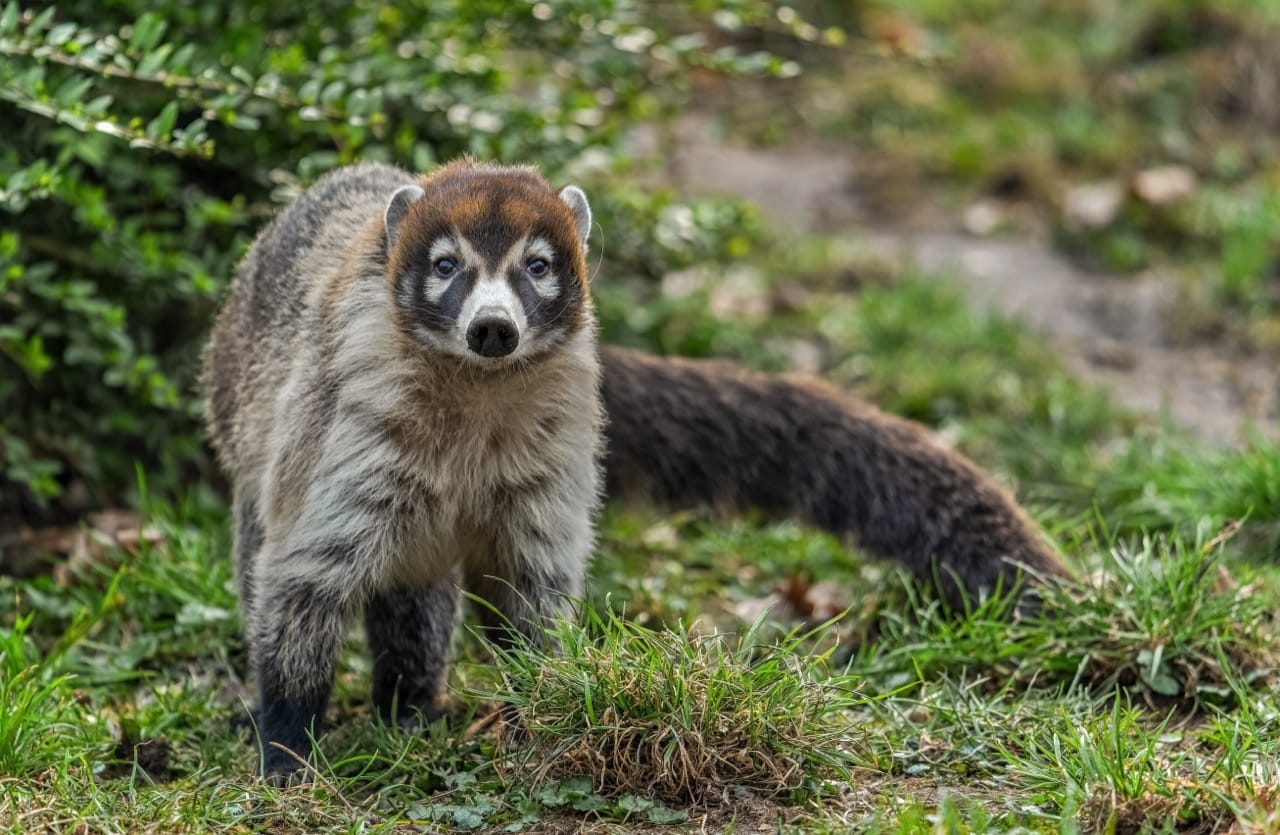
The white-nosed coati, known scientifically as Nasua narica, is a captivating creature that thrives in the diverse environments of the Americas. From the southern edges of Arizona to the lush rainforests of South America, this member of the raccoon family exhibits remarkable adaptability and an array of intriguing behaviors that make it a subject of interest both ecologically and scientifically.
Characteristics / Physical Description
The white-nosed coati is easily recognizable by its elongated snout, which is flexible and can rotate up to 60 degrees in any direction. This adaptation is particularly useful for foraging as it allows the coati to rummage through leaf litter and crevices to find food. Adults typically have a body length of about 41 to 70 cm (16 to 28 inches) and a tail almost as long, which they use for balance and signaling. Their fur ranges from brownish-red to gray, with a distinctive white mask around their eyes and snout.
Taxonomy and Classification
Nasua narica is a member of the Procyonidae family, which includes other small to medium-sized omnivores such as raccoons and kinkajous. The genus Nasua consists of two species, with the white-nosed coati being one of them. Genetic studies have shown that coatis are closely related to olingos, ringtails, and raccoons, sharing a common ancestor.
Behavior and Social Structure
White-nosed coatis are exceptionally social among procyonids, typically forming groups called bands, which consist mainly of females and their offspring. Males, however, are generally solitary or form smaller, less stable groups. These bands provide safety in numbers and help in the rearing of young. Coatis communicate using a variety of sounds, from whistles to chirps, which are crucial for maintaining group cohesion.
Habitat and Distribution
This species is versatile in its habitat preferences, residing in environments ranging from arid deserts in the north to tropical rainforests in the south. Their distribution spans from the southwestern United States throughout Mexico and Central America, down into Colombia. The adaptability of the white-nosed coati to various ecosystems is a testament to their evolutionary success.
Diet and Feeding Habits
Omnivorous and opportunistic, the diet of the white-nosed coati includes fruits, invertebrates, small vertebrates, and eggs. Their strong forelimbs and claws make them adept at both climbing trees in search of fruit and digging for insects. Seasonal variations significantly influence their diet, with fruits being more predominant in the wet season and animal prey in the dry season.
Breeding and Reproduction
Breeding season for the white-nosed coati is generally synchronized with the onset of the rainy season, which ensures ample food supply for the nursing females. After a gestation period of about 11 weeks, females typically give birth to 4-5 young. The offspring are cared for in a communal nest and are weaned at around four months old.
Relationship with Humans
While not typically regarded as a direct threat, coatis often venture into human-inhabited areas in search of food, which sometimes leads to conflicts. They are also hunted or captured for the pet trade in some regions, impacting some local populations. Conservation efforts are in place in various areas to manage their interaction with human activities and habitats.
Evolutionary History
The evolutionary lineage of the white-nosed coati tells a story of adaptation and survival. Fossil records indicate that their ancestors were present in North America as far back as the Pleistocene, adapting over millennia to expanding and contracting habitats due to climatic shifts.
Use as Research Animals
White-nosed coatis have been used in research to understand the social structures of meso-predators and their roles in ecosystem dynamics. Their adaptability also makes them valuable in studies related to habitat fragmentation and the impacts of human encroachment on wildlife.
The white-nosed coati continues to fascinate scientists and nature enthusiasts alike. Through continued study and conservation, we can ensure that this adaptable and resilient creature thrives, maintaining its role in the ecological tapestry of the Americas.